AI can help you get to a first draft faster. But in legal research, speed only counts if the result holds up.
That’s why this infographic exists. It sets out a simple way to pressure‑test AI‑assisted research before you rely on it – without turning a time‑saving tool into extra verification work.
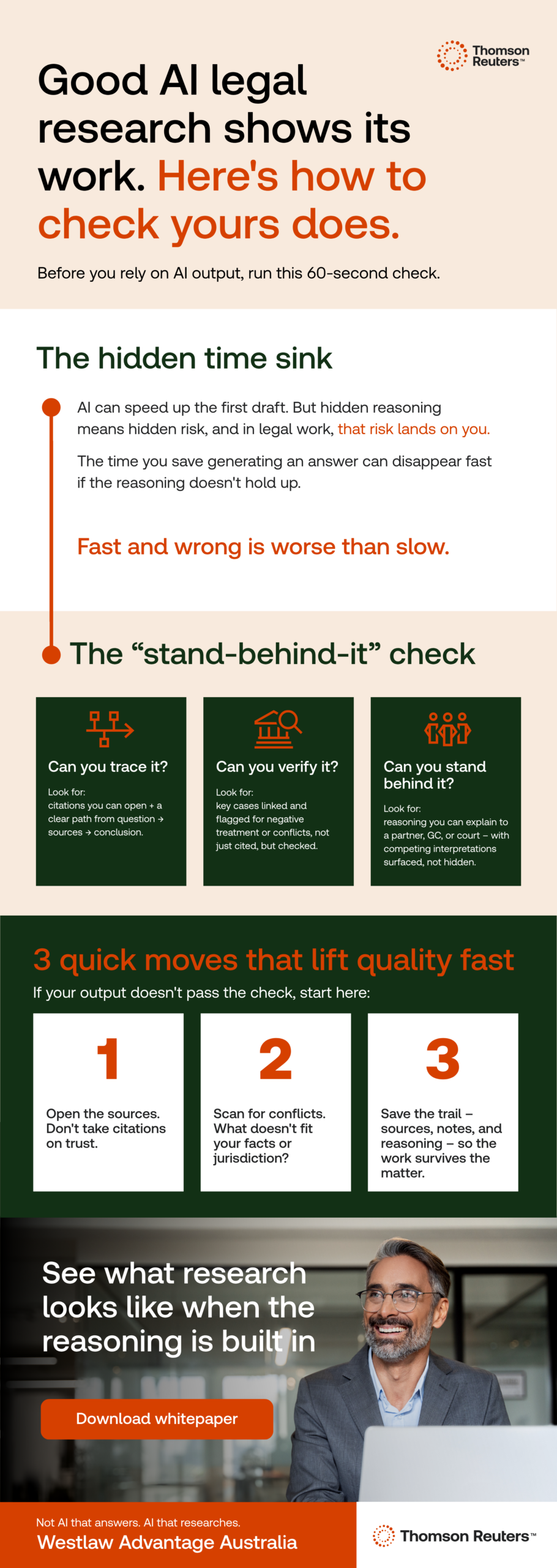
The visual walks through a 60‑second checklist covering core questions legal professionals routinely need to answer: Where did this come from? Is the authority current and relevant? And could you confidently rely on this output if it were challenged?
Why a quick check matters
Many AI tools can produce a confident answer in seconds. The cost often comes later.
When the reasoning behind an answer isn’t visible, responsibility shifts back to the researcher. You end up retracing steps, checking sources, resolving conflicting authority, and confirming currency, often under time pressure. In practice, that “verification tax” can wipe out the time you thought you saved.
This reflects a broader shift in how legal research is judged. Having an answer is no longer enough. What matters is whether you can explain how it was reached and defend it if questions arise. If you can’t do that, the research isn’t ready to use.
How to use the infographic in practice
This isn’t a theory piece. It’s designed as a moment‑of‑use check.
Use it when:
- you’re about to pass AI‑assisted research to a colleague or client
- the answer sounds right but you didn’t watch how it was built
- the stakes are high and you won’t have time to re‑check everything later
If one of the checks in the visual gives you pause, that’s useful signal. It points to where further review is needed – before the research leaves your desk.
Accuracy on its own no longer provides enough protection. Research needs to be defensible, not just plausible.
Where to go deeper
The thinking behind this checklist is grounded in research into what makes AI‑assisted legal research reliable in practice: transparent reasoning, verifiable authority, and a clear audit trail.
Those ideas are explored in more detail in How trustworthy content transforms legal deep research, which looks at how legal teams can move faster without losing control.
If AI is going to support real legal work, it has to do more than deliver answers. It has to show how it got there.