Corporate tax departments are feeling the strain of mounting complexity, shrinking resources, and slow-moving tech transformations. Research shows how under these current pressures, the gap between strategic ambition and operational reality is widening.
KEY TAKEAWAYS
- Penalties spike when resources and controls are stretched thin – Under-resourced tax departments face significantly higher penalty exposure, with nearly half reporting at least one penalty and one-in-eight experiencing fines exceeding $1 million USD.
- Reactive workloads erode savings and accelerate burnout – Tax professionals spend most of their time on reactive or tactical work despite preferring a 70/30 strategic/tactical split, creating an environment in which reaction consumes planning capacity.
- Incremental, targeted technology delivers faster returns than big-bang overhauls – Nearly 70% of tax departments remain in chaotic or reactive stages of digital transformation, with many tax professionals saying they lack confidence in their department’s ability to upgrade systems within two years.
Almost half (44%) of respondents to the 2025 State of the Corporate Tax Department report, published by the Thomson Reuters Institute in partnership with Tax Executives Institute, say their department had at least one penalty – and among under‑resourced tax departments, it was even higher, one-in-eight say these fines topped $1 million.
And when it comes to technology, large portions of tax department professionals say their departments’ approach to technology is either chaotic or reactive (69%), and two‑thirds say their departments aren’t currently using generative AI (GenAI) to improve efficiency within the department.
Fortunately, as thereport shows, there are steps that corporate tax department leaders can take, including:
- Treat penalty reduction as a board‑level KPI, tracking the number, value, and cause of penalties to better pinpoint control gaps.
- Direct a defined slice of the technology budget toward core preventives – such as data accuracy, filing automation, indirect‑tax determination, and reconciliation tools – that can cut errors before they become fines.
- Frame resource requests around real avoided penalty scenarios, because showing that incremental investment could have offset last year’s losses builds a more better case for future funding.
Ultimately, penalties and fines are data points that reflect a deeper problem and solving that requires visibility at the corporate governance level, not reactive patchwork after the fact.
The reactive work trap that quietly kills savings
The report found that tax professionals spend most of their time on reactive or tactical work. Also, nearly 60% describe their departments as under‑resourced – up from 51% a year earlier.
Having an under-resourced tax department can create an environment in which reaction consumes any planning and strategic work. The consequences compound quickly. More than half of respondents from under-resourced departments say they face penalties, and many also report missing tax-credit opportunities, delaying cross-functional projects, and operating with less confidence in their forecasts or liability management.
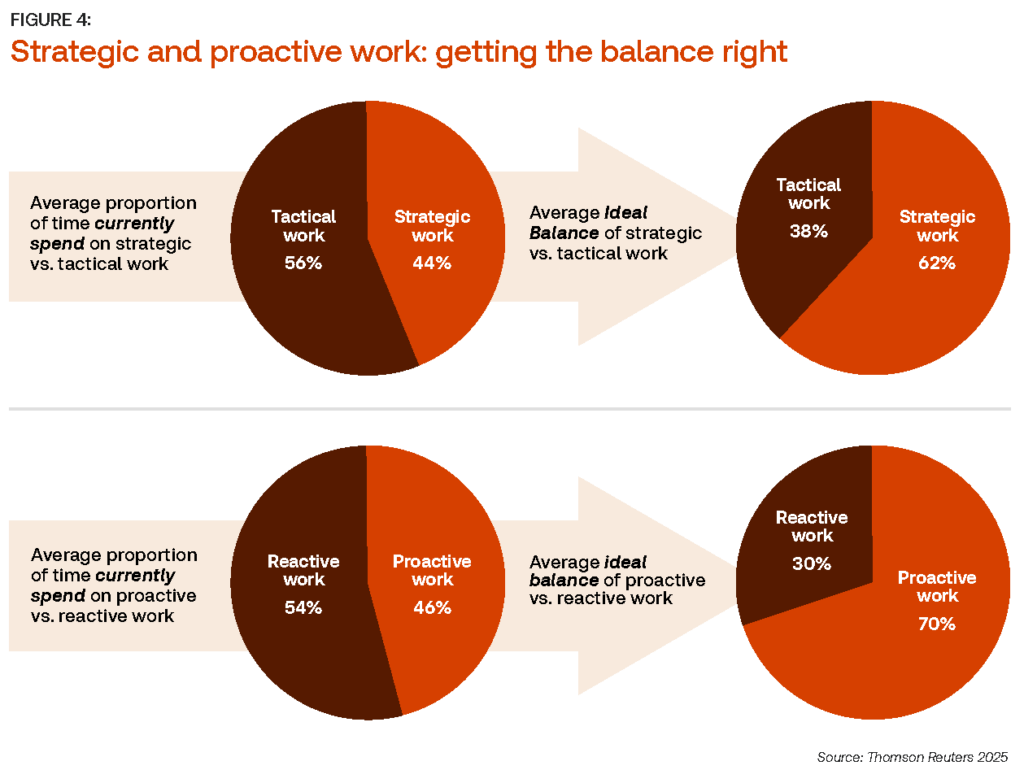
Not surprisingly, burnout is another hidden cost that under-resourced departments pay daily: Tax teams that are stretched through overtime to compensate for structural and personnel shortfalls often see reduced accuracy, just when judgment is most needed.
For Australian teams, the pattern can feel familiar: more jurisdictions, more data, more scrutiny – but not always more capacity. Whether you’re managing company income tax, GST, transfer pricing, or global minimum tax readiness, the work tends to arrive as “urgent” long before it becomes “strategic”.
Again, there are steps that corporate tax department leaders can take, including:
- Establish a proactive‑time floor and mandate that each week a fixed block of time is reserved for modelling, forecasting, or credit discovery – then, measure results in saved cash or lower effective‑tax‑rates
- Create a rapid‑triage lane for repetitive fire drills that would allow you to codify recurring crises – such as late adjustments, jurisdictional queries, or document chases – and then automate the intake so these tasks stop devouring cognitive bandwidth
- Invest in targeted capacity, not generic headcount; adding a tax‑tech analyst or process‑automation specialist yields more lasting leverage than simply dividing the same tasks among already overworked staff
In much of this, the bigger insight is cultural: Reclaimed time is reclaimed value. Every hour shifted from reactive compliance to predictive analysis strengthens your tax department’s compliance posture.
Tech hesitation is expensive; smaller faster wins matter more
As the report shows, almost 70% of respondents say their tax departments are still in the chaotic or reactive stages of digital maturity, and barely 6% operate optimally. Further, nearly 60% of respondents say they lack confidence in their ability to upgrade systems within the next two years.
This correlation between reactive approaches and technological stagnation can feed directly into a department seeing increased penalties and an overreliance on manual processes.
Interestingly, corporate tax departments in smaller organisations, those with less than $50 million in annual revenue, and those from very large organisations, with more than $5 billion in annual revenue, are outpacing their midsize peers when it comes to technology purchases and integration. In fact, these two groups – at opposite ends of the market – are more likely to secure leadership buy‑in, tap external vendors for automation, and climb faster toward proactive operations.
Of course, GenAI sits on the cusp of this changing that trajectory. More than half (57%) of respondents say their tax departments are implementing new technology this year, including GenAI-driven tools. And those departments that are, mainly are using it for research, summarisation, and document drafting, rather than more complex integrated tax analytics.
However, without a reliable tax data backbone – clean, centralised, and accessible data – even the smartest model can’t deliver true automation or insight.
Still, as the report outlines, there are actions that tax department leaders can take now to boost their department’s tech prowess, including:
- Prioritise fast‑ROI automations, such as indirect‑tax determination, e‑invoicing compliance, tax‑provision close tasks, and certificate management. These are proven areas in which automation immediately cuts cycle times and penalty exposure. But remember to keep an eye on the wider ROI benefits to the organisation.
- Pair early GenAI pilots with structured data. For example, start with narrow copilots for research or variance explanation, but feed them curated internal data to evolve beyond guesswork and toward data-driven decisions
- Borrow capacity intentionally and partner with third‑party automation specialists for discrete projects using a build‑operate‑transfer model. This way, internal teams inherit sustainable, well‑documented workflows rather than black‑box solutions.
Waiting for a full replacement of the organisation’s enterprise resource planning system or a perfect end‑to‑end tech stack actually can trap departments in perpetual backlog. Incremental wins, particularly those tied directly to penalty reduction or labour savings, can build the momentum and political capital needed to make the case for proper resourcing for larger transformations.
The bottom line
The 2025 State of the Corporate Tax Department report reveals a powerful connection between resource allocation and tax department performance: under-resourcing perpetuates penalties and reactive workflows that can only be broken by shifting to proactive systems and automation. For tax department leaders, the imperative is clear – invest in prevention, reclaim strategic time, and modernise incrementally, because true progress comes not from doing more, but from choosing fewer priorities and executing on those select ones with excellence.
This article is adapted for Australian audiences from Thomson Reuters global research and commentary, including findings from the State of the Corporate Tax Department report.