Explore the latest development in indirect tax compliance automation
Highlights
- Touchless compliance uses agentic AI to autonomously manage GST tax processes with minimal manual intervention.
- Traditional automation reduces time spent, while touchless compliance fundamentally changes the work tax teams perform.
- Advanced systems enable scalability, real-time visibility, and strategic capacity creation without increasing headcount (or headaches).
Tax automation has evolved beyond traditional software that simply calculates rates and populates returns. While these tools improved manual processes, tax teams still spend countless hours validating data, investigating anomalies, and reconciling discrepancies.
The pressure to close that gap is only growing. The ATO is actively moving businesses toward more frequent GST reporting cycles, its compliance systems increasingly AI-assisted, and globally, tax authorities are accelerating e-invoicing mandates, near-real-time reporting requirements, and prefilled return programmes – compressing the time teams have to catch errors before they become audit exposure.
Touchless compliance represents the next evolution – an end-to-end approach that leverages intelligent agentic automation to manage the entire indirect tax compliance process with human intervention by design.
Defining touchless compliance
Touchless compliance combines precise automation with agentic AI capabilities to create workflows that don’t just execute tasks but manage processes autonomously. Some industry practitioners also refer to this as autonomous tax compliance, zero-touch processing, or intelligent compliance automation.
Leading practitioners in the space describe this approach as “touchless by default, manual by exception.” This is a fundamental shift from traditional automation approaches.
Think of it this way: Traditional automation does what you tell it to do. Touchless compliance understands what needs to be done and does it.
This distinction matters because GST tax compliance involves continuously changing rules and regulations, as well as reporting requirements, across jurisdictions – and for multinational organisations, that means navigating a patchwork of VAT, GST, and digital reporting obligations across dozens of countries, each with its own filing cadence, e-invoicing mandates, and authority requirements.
How touchless compliance works
At its core, touchless compliance systems leverage agentic AI and machine learning that acts autonomously rather than following predefined rules:
- Intelligent data management
Actively validates transaction data, identifies anomalies, and flags quality issues so that users stay in the loop and make the final judgement call based on suggested actions. This includes detecting missing data, identifying outliers, and flagging potential errors before they impact filing accuracy. - Proactive process execution
Monitors filing calendars and continuously prepares returns for each filing period, adding data as it comes in, so that users can review on an ongoing basis and see progress/outcomes in advance. - Autonomous anomaly detection
Uses machine learning to analyse patterns and flag compliance issues before they become problems. The system recognises unusual transaction patterns, unexpected tax liability changes, and potential audit triggers. - Dynamic stay-current technology
Adapts automatically as tax rates change, new requirements emerge, and jurisdictional rules evolve. This includes monitoring legislative changes, rate updates, and new regulations. - Contextual intelligence
Understands data relationships and recognises when GST registration thresholds are crossed, prefill variances require explanation, or cross-border transaction rules change. The system maintains awareness of business context, not just transactional data.
The human-in-the-loop advantage
Touchless compliance keeps humans in control while eliminating tedious manual work. Although touchless compliance dramatically reduces manual intervention, tax professionals remain essential for complex judgement calls, unusual transactions, and strategic oversight. Tax professionals handle exception management, maintain strategic oversight, and make judgement calls while AI handles routine execution. The system learns from human decisions and provides full transparency into automated processes.
Beyond traditional automation
To understand the leap forward touchless compliance represents, consider the differences:
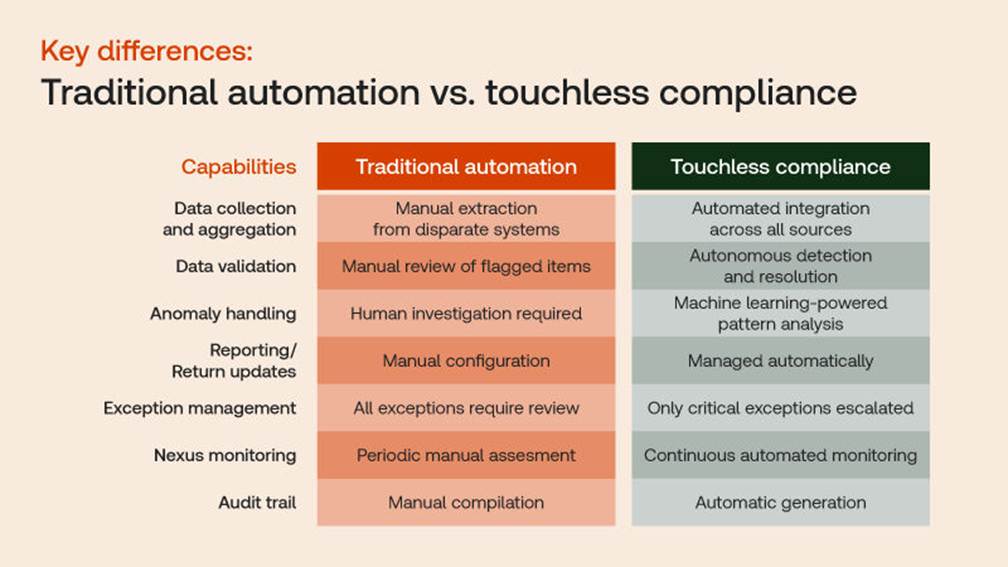
Traditional automation requires you to design the workflow, configure every rule, manually feed data through each step, review outputs for accuracy, and intervene when anything unexpected occurs. It makes existing processes faster but doesn’t fundamentally change how work gets done.
Touchless compliance manages the workflow autonomously, adapts to new situations without reconfiguration, identifies and resolves many issues independently, and focuses your attention only where it’s truly needed. Any changes or decisions made by AI still require final sign-off by a user and are well-documented and fully auditable, ensuring you retain ultimate control. It changes what work you do, not just how quickly you do it.
Traditional automation might reduce a 40-hour compliance process to 25 hours. Touchless compliance might reduce it to 10 hours – and those 10 hours are spent on strategic review and decision-making rather than manual data processing.
Key differences: Traditional automation vs. touchless compliance
What advanced automation enables
The shift to touchless compliance creates possibilities that traditional automation simply cannot deliver:
- Scalability without staffing
Process significantly more returns, often 2-3x the volume, without increasing headcount. For a multinational expanding into new markets – triggering new VAT registration obligations in the EU, or navigating e-invoicing mandates in LatAm or APAC – the same principle applies: touchless compliance automatically identifies new requirements, configures the relevant filing types, and monitors deadlines, removing weeks of manual setup. - Real-time compliance visibility
Instead of discovering issues during return preparation or worse, during audits, you maintain continuous awareness of your compliance position across all jurisdictions. - Proactive risk management
Advanced systems identify potential problems before they materialise, giving you time to address issues rather than react to crises. This includes early detection of invalid ABNs, missing or inconsistent tax codes and rates, and unusual liability patterns. - Strategic capacity creation
With significant reduction of manual effort, your tax team gains capacity for the strategic initiatives that drive business value through business partnering, planning for business expansion, process optimisation, and cross-functional collaboration. - Audit readiness by default
Comprehensive documentation and clear audit trails are generated automatically as part of the compliance process, not assembled after the fact. This includes transaction-level detail, decision logs, and change tracking for both agent and user. - Faster response to business changes
When your company launches new products, enters new markets, opens new locations, or completes acquisitions, compliance systems adapt rapidly rather than requiring weeks of manual setup.
The Thomson Reuters vision
Thomson Reuters ONESOURCE Indirect Compliance AI, powered by CoCounsel, is built around this model. Available 3 July 2026 in Australia, it combines rules-based orchestration, agentic AI, and human-in-the-loop controls to move global VAT and GST returns to a ‘Review Ready’ state continuously, rather than in a deadline-driven rush. The approach is designed to be explainable and auditable, not a black box.
“At Thomson Reuters, our Corporates vision is clear – compliance should be touchless by default, manual by exception. This isn’t just automation; it’s a fundamental reimagining of the tax function, freeing professionals to drive strategic business advantage.”
Ray Grove ,Head of Product, Corporate Tax and Trade, Thomson Reuters
The transition ahead
The shift to touchless compliance isn’t a future state – for many tax teams, the pressure is already here. Tighter reporting cycles, expanding e-invoicing mandates, and authorities that increasingly know what your return should say before you file it: the conditions that made manual compliance manageable are quietly disappearing.
The organisations that will navigate this well aren’t necessarily the ones with the largest tax teams. They’re the ones that have stopped treating indirect tax compliance as a deadline-driven scramble and started treating it as a continuous process – one where the hard work happens in the background, and the team’s energy goes into judgement, not data handling.
That shift doesn’t happen overnight. But knowing what touchless compliance actually means – and what it doesn’t – is a reasonable place to start.